The Waterfront Economy, Part Two: The Harder Questions Sydney Needs to Answer
Hoyne's Place Strategy Director, Tom Oliver Payne on land, governance and the many waterfronts Sydney has yet to make the most of
There’s a stretch of water running through south Sydney that most people never think to look at twice. Alexandra Canal doesn’t appear on postcards, and few people would think to photograph it at sunset. It runs past fences and warehouses, carrying stormwater towards the Cooks River. Standing beside it today, it’s hard to believe anyone once imagined it as part of a shipping route between Botany Bay and Sydney Harbour. The route was never finished, and industry left contaminated sediments behind.
I find myself drawn to places like this precisely because they receive so little attention. Sydney has good reason to focus on its great harbour foreshores. But what could happen if we brought some of that imagination to the other places where Sydney meets the water, places we’ve spent decades turning our backs on?
In part one of this series, Andrew Hoyne made the case for what would make Sydney’s next waterfront feel unmistakably like Sydney: distinctiveness, genuine engagement with the water, a reason to stay rather than pass through. I want to pick up where that leaves off. Because whether a waterfront becomes a place people can use and care about depends on decisions made well before the design begins: who owns the land, who governs it, what we choose to retain, and whether working waterways have a place in Sydney’s future.
A once-in-a-generation opportunity
Blackwattle Bay, Central Barangaroo and Bays West offer unusual opportunities to shape large stretches of Sydney’s waterfront. Government still owns significant land and has a decisive role in what happens next. That’s no small thing. Once land like this passes into private, fragmented ownership, the chance to shape it as a single coherent vision becomes much harder. We should be ambitious about them now.
But the less prominent waterfronts raise another question. Places like Alexandra Canal do not arrive as a single, neatly bounded project. The waterway and the land beside it have different owners, uses and constraints. How do we build a shared ambition for places like that?
Governance shapes the outcome before design begins
We tend to talk about waterfronts as design problems, because design is the part we can see. But long before a single building is drawn, decisions are made about who is in the room and what they can decide together. Those choices shape what designers can achieve later.
Where a precinct spans multiple landowners, this becomes acute. Left alone, each owner optimises their own parcel, and the precinct ends up as a patchwork of individually sensible decisions that add up to nothing coherent.
A Business Improvement District offers one way to organise shared priorities and investment across ownership boundaries. The New Sydney Waterfront Company, for example, is exploring that kind of coordinating role along the western harbour. Could a similar structure help landowners and public agencies work towards a shared vision for Alexandra Canal or the Cooks River, where no single project can shape the whole waterway?
Growth that reinforces character, rather than erasing it
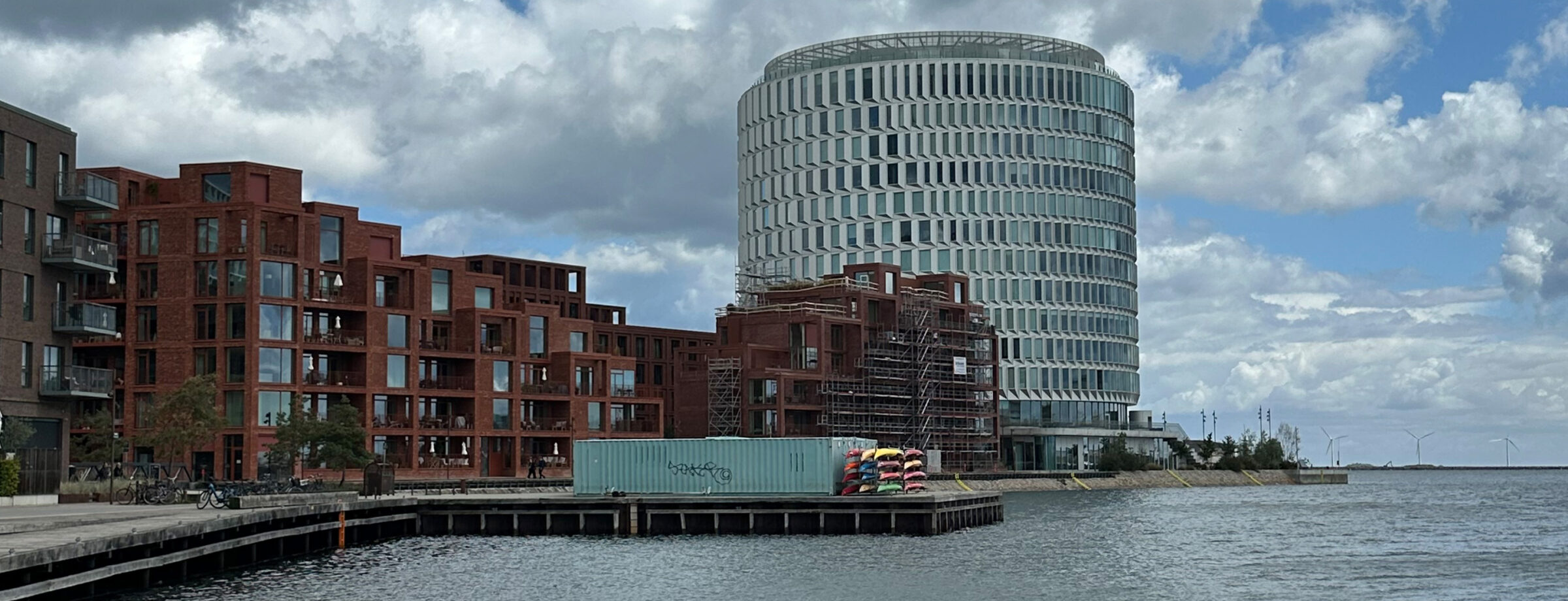
Nordhavn in Copenhagen shows what it can mean to build a new district out of an old industrial harbour. Former grain and cement silos have found new uses, while the quays and harbour basins still give the neighbourhood its shape. People can walk, hang out and swim along an edge that was once given over to industry. Its character comes from being able to see what the place was and use it differently now; the harbour’s past is present in more than the names of its streets or the appearance of its new buildings.
Bays West faces a similar question, but Sydney’s waterfronts don’t all have the same character to draw from. Callan Park, for example, is a beautiful piece of harbour parkland shaped by its long history as a mental health hospital. There have been calls to make it a wellness sanctuary. What could that mean for the place as a whole, including its foreshore: somewhere for care, recovery and respite that grows out of its history rather than setting it aside? The opportunity is to make more of these differences, not produce a recognisable formula for a “Sydney waterfront”.
Heritage is an asset, but it is not a business model
Maritime and industrial heritage can make a place feel instantly distinctive, and Sydney has more of it than it usually gives itself credit for. But I think we’ve become a little too comfortable leaning on heritage as the whole story, rather than one part of a longer one. Cockatoo Island is genuinely extraordinary, but preserving its buildings and keeping it open to visitors takes continuing investment. That might come from public funding, commercial uses, or both. A heritage narrative can get people through the gate. It can’t be the only thing keeping the gate open. But as we find commercially viable uses for these places, how much of their history can we remove before the story itself becomes impossible to read?
At the former Balmain Power Station site on Iron Cove, one small pumphouse remains in Bridgewater Park, surrounded by the rendered apartment buildings of Balmain Shores. Walking through, I find it hard to grasp the scale of the power station, how it worked, or how it shaped this part of the harbour. The pumphouse feels stranded without the industrial landscape that once gave it meaning. Housing and public space have brought new life to the site, but much of what could have made that new place distinctive has been lost.
Ports as places, not always problems to relocate
Relocation is the default instinct whenever working industry sits on land someone else wants. I’m not convinced it should be. There are strong international examples of working ports coexisting with genuinely public waterfronts, cranes and cargo alongside people actually spending time there, rather than being pushed to the city’s edge to make way for leisure. There’s something honest and theatrical about a waterfront that lets you watch real work happen instead of one that’s been entirely tidied up for leisure and consumption. Sydney still has working harbour character in places. How might we design public life around it where that is safe and practical?
Cape Town’s V&A Waterfront makes the point well. It sits on the oldest working harbour in the Southern Hemisphere, fishing boats still working the docks alongside a contemporary art museum, a dry dock, and eighty-odd places to eat. The lesson isn’t that every industrial waterway should become a destination. It’s that industry, culture, recreation and F&B don’t have to compete for the same stretch of water. Combine them well, and you often end up with something more compelling than either, and just as functional.
The basic principle is to protect industry that genuinely needs waterfront access, reconsider uses that no longer depend on it, and, wherever possible, design public life around the work that remains. That will mean different things at a deep-water port and along a former freight canal. Neither should be treated as empty land awaiting the same kind of redevelopment.
More ways to use the water
Across its 37 hectares, Wynyard Quarter has brought homes, businesses and public space to a former industrial waterfront while retaining fishing and marine activity. Its first stage opened 500 metres of waterfront to the public and at nearby Karanga Plaza, steps now lead down to a free harbour pool: a place where people can do more than look at the water.
Sydney has plenty of moored boats, but relatively few places where people can readily experience the water themselves. That could be as simple as a place to launch a boat or sit at the water’s edge. Each opportunity would need to respond to the waterway and the work already there. Creating more public access means making deliberate choices about which marine businesses need to stay beside the water.
The islands sitting right in front of us
I’ve spent enough time on the harbour to notice how many islands sit there, looking abandoned even when they aren’t. Cockatoo Island aside, several feel as though they are waiting for a clear purpose. Transport is a genuine barrier to bringing more people to the islands. But past work with First Nations communities on Memel, or Goat Island, showed me what becomes possible when they shape the vision from the outset. The challenge is to find uses that can fund the islands’ care and make them easier to experience, while respecting each island’s history.
Fish markets as a model, not just a project
Sydney’s fish market was already a working waterfront people wanted to visit. The new development has brought the public closer to that work. From the promenade and amphitheatre steps, visitors can watch boats arrive and fish being unloaded; inside, the market hall and places to eat give them reasons to stay. The trade hasn’t been pushed aside to create a destination. It’s what makes the destination worth visiting. What other working waterfronts in Sydney could make room for public life around the work that happens there?
Where this leaves us
Blackwattle Bay, Central Barangaroo and Bays West will rightly attract attention as Sydney’s waterfront changes. But its future also lies along canals and rivers, at working wharves, within parklands and on islands. Each asks something different of us: better access to the water, a viable use for heritage, room for industry to continue, or a new purpose for land that no longer needs to work as it once did. When I ride beside Alexandra Canal, I wonder how many other places Sydney has learned to pass without seeing.
Sydney does not lack character along its water. The challenge is to open more of it to people while sustaining the work and heritage that give these places their purpose. Ownership, investment and governance may be less visible than architecture, but they determine what can stay, what can change and who gets access. Get those decisions right, and more of Sydney’s waterfront can become accessible without becoming less itself.
Back