Unlocking Australia’s dormant rail corridor land
Australian rail corridors are treated as the back-of-house of the city. We think it's time to change that.
Australia is a country shaped by distance. Our cities have grown along rail lines that once connected emerging suburbs to ports, industry and city centres. Today, those same rail corridors cut through some of the most valuable and strategically important land in the country. Yet hidden in plain sight alongside them is one of Australia’s greatest untapped public assets: thousands of hectares of dormant, state-owned land sitting adjacent to active rail corridors.
For decades, much of this land has remained fenced off, underused and effectively forgotten. In some cases, it has sat untouched for more than a century. These are the leftover spaces beside the tracks: the broad grassy verges, strips of scrubland, vacant lots and disconnected fragments of land that run through our suburbs and cities. They were once reserved for safety clearances, future rail expansion or operational purposes. But in many locations, advances in rail technology, signalling and infrastructure planning mean they are no longer essential to the network. And yet they remain unused and forgotten.
At a time when Australia is facing a housing affordability crisis, a shortage of public open space and growing pressure on infrastructure, the continued dormancy of this land is more than a missed opportunity. It is a failure of imagination.
A legacy of inertia
Every Australian capital city contains hundreds of kilometres of rail corridor land. Often there are strips of public land between 10 and 100 metres wide running alongside the tracks. In other places, these corridors widen into vacant lots, car parks, dumping grounds and other fenced-off parcels that contribute little to the surrounding community. The scale is staggering.
The rail corridor between Caulfield and Dandenong in Melbourne passes through some of the fastest-growing and most diverse communities in the country. Yet kilometre after kilometre is bordered by underutilised land. In Sydney, the lines between Central and Parramatta, and through suburbs such as Marrickville, Tempe and Sydenham, pass barren strips of dirt, weeds and fencing that disconnects rather than contributes. Brisbane’s rail corridors from South Bank to Beenleigh cut through areas where demand for housing, community infrastructure and public space is rising sharply, while Perth’s Midland and Armadale lines travel beside long stretches of land that could be doing much more.
These spaces are not operationally critical. They are simply the legacy of outdated planning assumptions and bureaucratic inertia. We have inherited a model of public land stewardship that is too passive. Land is retained because it has always been under the control of a rail authority, rather than a planning authority.
The result is a vast portfolio of publicly owned land sitting idle in precisely the locations where our cities need housing most.
The opportunity hiding in plain sight
The conversation about housing and growth in Australia is often framed as a choice between densifying existing suburbs or continuing to push outward into greenfield areas. But there is another option. Rail corridor land offers the chance to create new housing, parks, education facilities, retail and community infrastructure within existing suburbs, close to transport, jobs and services.
Through modern noise attenuation, landscape buffers, podium buildings, elevated structures and careful master planning, it is entirely possible to create places that are attractive, safe and deeply connected to the communities around them.
This is not about compromising the rail network. It is about using the land around it more meaningfully. With thoughtful planning and good design, active rail corridors can coexist with new uses. Around the world, cities have shown that it is entirely possible to build safely and successfully alongside rail infrastructure.
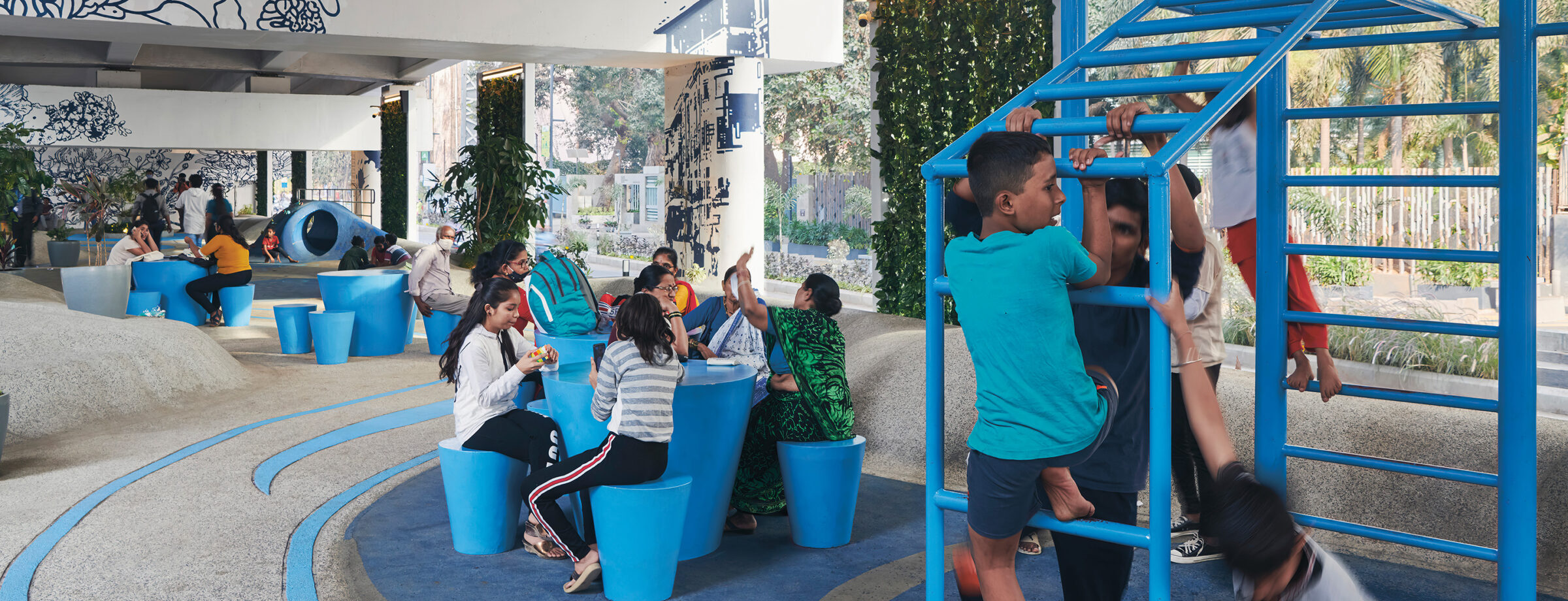
In Tokyo, narrow parcels beside train lines have been transformed into tiny restaurants, pocket parks, local retail and micro-apartments. In London, land around the Overground network has become the catalyst for urban renewal and transit-oriented development. In India the One Green Mile project (featured in The Place Economy Volume 3) has seen the creation of 200-metre-long community space, a series of outdoor ‘rooms’ including a lounge, gym, seating areas, performance space, and reading room. And in New York, the High Line demonstrated how neglected rail infrastructure could be reimagined as one of the world’s most celebrated public spaces. Australia has the opportunity to take this idea even further. Unlike New York’s High Line, we do not need to wait for rail lines to become obsolete. Rather, our existing rail infrastructure is critical, and while we’d like to see a huge increase in rail use, that will not stop the land beside our active corridors being repurposed now.
More than housing
The potential of these corridors extends far beyond housing. Yes, they could help deliver tens of thousands of new homes in locations connected to existing community and with excellent access to public transport. That alone would make a meaningful contribution to addressing Australia’s housing crisis.
But the opportunity is broader and more powerful than that. In many middle-ring suburbs, there is an acute shortage of public open space, sports fields, schools, childcare, health services and places for local businesses to thrive. Rail corridor land could help fill those gaps. Imagine rail-side linear parks linking fragmented neighbourhoods. Imagine small-scale retail, cafés and community hubs stitched into station precincts. Imagine student housing or affordable housing close to universities and employment centres. Imagine new bike paths and green corridors connecting suburbs that are currently divided by the railway line.
These are not grand, utopian ideas. They are practical interventions that would make cities more liveable, equitable and connected. In many cases, the land is already publicly owned. The challenge is not acquisition. It is vision and action.
Where Australia could start
The opportunities are visible across the country. In Sydney’s Inner West, the Bankstown, Inner West and Illawarra lines run through dense suburbs where population growth is accelerating but access to open space remains limited. Rail-side parks, local retail and student housing could transform these communities. In Melbourne’s south-east, the corridor from Caulfield through to Clayton passes employment centres, hospitals and multicultural neighbourhoods where there is an urgent need for affordable housing, sports facilities and education infrastructure. In Brisbane, underused land beside the rail lines through Alderley, Woolloongabba and Logan Central could support missing-middle housing and flexible community spaces. In Adelaide’s northern suburbs, the corridors through Elizabeth and Salisbury contain broad verges and underutilised land that could become walkable neighbourhoods, regenerated bushland or new civic spaces. And in Perth, the Fremantle and Armadale lines travel through established suburbs with mature infrastructure but little room left to grow.
Unlocking adjacent public land could provide critical infill opportunities. These places already have transport. They already have schools, jobs and services. What they often lack is the land to evolve. The rail corridor provides it.
A different model of public land stewardship
The answer is not to sell this land off indiscriminately. These assets should mostly remain in public ownership. But public ownership does not have to mean public inactivity. We need a new model that allows governments to unlock these sites through long-term leases, partnerships with community organisations and state government housing organisations, development agreements and carefully designed planning frameworks.
The objective should not simply be to maximise financial return. It should be to maximise public value. That means using this land to deliver:
- More housing in transport-rich locations
- More parks and recreation spaces in suburbs that need them
- More opportunities for local businesses and employment
- More connected and walkable neighbourhoods
- More sustainable growth that reduces pressure for endless suburban expansion
This is ultimately a question of stewardship. The land beside our rail lines is already owned by the public. The question is whether we are prepared to use it in the public interest.
The civic boulevards of tomorrow
Too often, rail corridors are treated as the back-of-house infrastructure of the city: necessary but hidden. They create edges, barriers and forgotten spaces. But they do not have to. With imagination, collaboration and political will, these corridors could become some of the most important civic spaces in our cities.
The fenced-off margins of today could become tomorrow’s green corridors, housing precincts, local high streets and public parks.
At a time when Australia is searching for ways to build more housing, create more liveable communities and make better use of the assets we already own, the answer may be hiding in plain sight beside the railway tracks. Sometimes at a scale that is hard to fathom. So, we should stop accepting these places as wasted space. We should start seeing them for what they could become.
Back